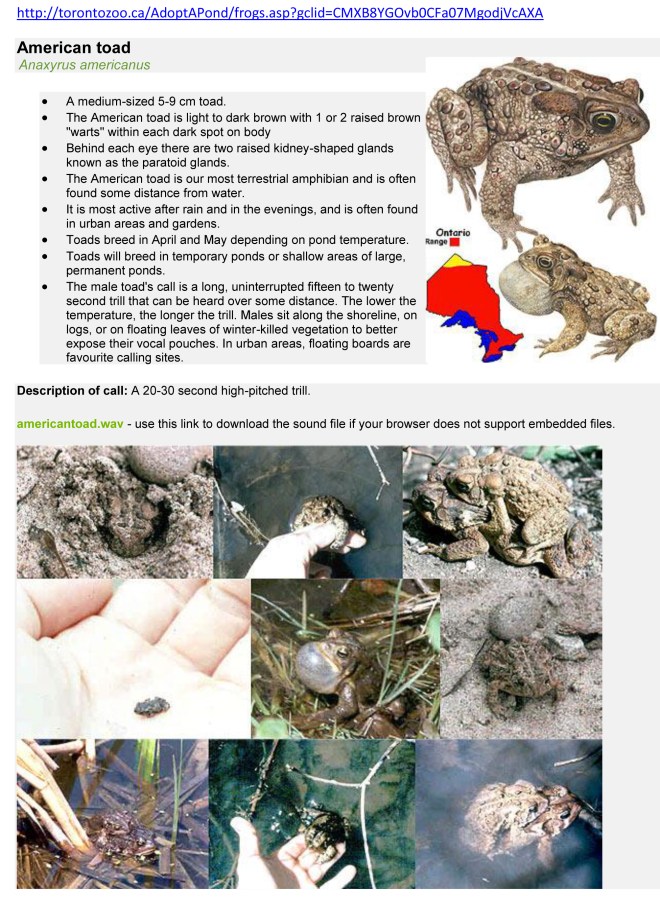
Learn more about the American Toad, one of the many frog species that inhabits North America and can be found in the Oxford area.

Learn more about the American Toad, one of the many frog species that inhabits North America and can be found in the Oxford area.
The snapping turtle occurs, though it is primarily limited to the southern part of Ontario. They are found in Mountains. The snapping turtle’s range is contracting, and the Committee on the Status of Endangered Wildlife in Canada lists it as a species of special concern.
The Snapping Turtle, or the Chelydra serpentine, is the largest freshwater turtle in Canada. With a range that extends from Canada through areas of the United States east of the Rocky Mountains all the way to Ecuador, the Snapper is found in Canada from the Maritimes west into southern Saskatchewan and parts of southern Alberta, with isolated populations in New Brunswick, but only in the southern part of Ontario. (The following map shows the range of the turtle in Southern Ontario: http://www.ontarionature.org/protect/species/reptiles_and_amphibians/map_snapping_turtleSO.html)
You’ll be forgiven if you think the “snapper” looks like something out of Jurassic Park. The Snapping Turtle is certainly most prehistoric-looking turtle species to be found in Ontario, with a long tail (which can be longer than their bodies) that has a series of triangular spikes along the top that are reminiscent of those of a stegosaurus. The Snapping Turtle reaches an average length of 20-36 cm and a weight of 4.5-16.0 kg. The carapace (upper shell) is very small (47 centimetres is the maximum length), is tan or olive to black in colour, has a coarsely serrated anterior (front) edge and three longitudinal ridges, and is often covered with algae. The plastron (lower shell) is also very small.
Hatchlings from “clutches” that could contain up to 60 ping-pong-ball-shaped eggs at a time are about the size of a loonie and are smaller (two to three centimetres in length) and darker than adults, with pronounced ridges along the length of their shell.
The Snapping Turtle is named such because, unable to withdraw completely into its shell for protection. Although adult Snapping Turtles have few natural predators, they nevertheless have developed a defence of snapping repeatedly to scare potential enemies away. In water, the Snapping Turtle rarely snaps at people or other potential threats and will simply swim away if threatened.
Snapping Turtles spend most of their lives in water and they can be found in almost any freshwater habitat. The irony is that they are not particularly good swimmers, often observed as simply walking on the bottom. Therefore, their preference is to shallow waters near abundant vegetation so they can hide under the soft mud and leaf litter, with only their noses exposed to the surface to breathe. It may be surprising how small the wetlands are that they inhabit, including ponds and ditches. They will hibernate in the mud or silt on the bottom of lakes and rivers, usually not too far from the shore.
During the winter months, Snapping Turtles bury themselves in the mud at the bottom of a pond to keep themselves from freezing. While they may move a little during this period, they normally will not eat.
Snapping Turtles will take advantage of man-made structures for nest sites, including roads (especially gravel shoulders), dams and aggregate pits as well as embankments or a shoreline. In Ontario, females do not begin to breed until they are 17 to 19 years old. They dig a nest in late May or June in an open area, usually one with loose, sandy soil, almost any area they can excavate.
They are omnivorous and feed on various aquatic plants and invertebrates, as well as fish, frogs, snakes, small turtles, aquatic birds and relatively fresh carrion. Approximately 90 percent of their diet consists of dead animal and plant matter, and this species plays an important role in keeping lakes and wetlands clean.
A Snapping Turtle will normally take 15-20 years to reach maturity and has a slow reproduction rate. Adults can live up to 70 years in the wild. As a result, the loss of even a few turtles from a population each year is enough to cause the population to decline. Snapping turtle populations are vulnerable to the threats of road mortality, hunting and poaching. Eggs in nests around urban and agricultural areas are subject to predators such as raccoons, herons, hawks, crows, large fish, snakes, and striped skunks.
Despite the snapping turtle being a species at risk in Ontario, the hunting of the species is still legal.
A medium-sized songbird found in North American tallgrass prairie, other open meadows and hay fields, male Bobolinks are black with a white back and yellow collar during their summer breeding season. (Some have described their striking look as wearing a tuxedo backwards.)
Bobolink molt twice a year, completely changing all their feathers on both the breeding and wintering grounds. When the male grows new feathers on the wintering grounds they all have yellowish tips, so he still looks like a non-breeding bird. Eventually the pale tips wear off to reveal his striking black-and-white breeding colors.
By late summer, male bobolink will lose much of this breeding plumage and more closely resemble the female’s tan colour with black stripes.
Bobolinks are related to blackbirds, which are often polygynous, meaning that males may have several mates per breeding season. Bobolinks are polygynous, too—but they’re also often polyandrous: each clutch of eggs laid by a single female may have multiple fathers.
Because Bobolinks spend much of their time out of sight on the ground feeding on insects and seeds, they may seem to appear out of nowhere, spotted flying in the sky or over the tops of vegetation singing a bubbling musical song.
The Bobolink breeds across North America. Here, in Ontario, it is widely distributed throughout most of the province south of the boreal forest, although it may be found in the north where suitable habitat exists. The Bobolink is considered a “wide ranging species” and in fact, the Bobolink is one of the world’s most impressive songbird migrants, travelling approximately 20,000 km to and from South America. Throughout its lifetime, it may travel the equivalent of 4 or 5 times around the circumference of the earth.
Bobolinks often build their small nests on the ground in dense grasses. Both parents usually tend to their young, sometimes with a third Bobolink helping. The species name of the Bobolink, oryzivorus means “rice eating” and refers to this bird’s appetite for rice and other grains, especially during migration and in winter.
A map outlining occurrences of the Bobolink in Ontario can be found at:
March 20, 2014 has been designated World Frog Day (also known as Save the Frogs Day) to coincide with the first day of spring. (The release, a day later, of Muppets Most Wanted, starring perhaps the world’s most famous frog, Kermit, is just a happy coincidence.)
First celebrated in 2009, World Frog Day has become the world’s largest day of amphibian education and conservation action. Many are using this designated day to focus on the worldwide decline in the amphibian population in locations across the globe. Today, one-third of the world’s amphibian species are threatened with extinction. Since 1979, 200 frog species have disappeared completely. This decline in population has been attributed to disease, habitat destruction and modification, climate change, pollution and pesticide use.
In 2013, over 270 events were held as part of Save the Frogs Day in 30 countries around the world.
There is evidence that the frog has been around for 200 million years. Today, there are approximately 5,000 species of frogs in the world from the Wood Frog that freezes and then thaws every winter to the Australian Rocket Frog who can leap over 50 times its own body length. Frogs of one species or another can be found on every continent, with the exception of Antarctica.
How the Frog Helps You
For more information, visit www.savethefrogs.com
This Week’s Endangered Species is the Barn Swallow (Hirundo Rustico). Although of African Origin, the Barn Swallow has the largest range of any swallow, found in Europe, Asia and Africa as well as the Americas.
The Barn Swallow is distinguished from other swallows by having a wider breast band and less white in their tails. They also fly much lower than most other swallows.
They associate closely with humans, nesting in buildings and other structures.
Celebrate Canada Water Week at an event near you:http://canadawaterweek.com/events/all?province=9&page=1
TVO Celebrates Canada Water Week with a lineup of programs. Plan your week’s TV viewing by visiting this link.http://ww3.tvo.org/special/tvo-marks-canada-water-week
Volunteer for the Ingersoll District Nature Club. We’d love to have you. You can learn more at: http://www.workinoxford.ca/index.php/volunteer/guest/detailjob/2571-ingersoll-district-nature-club-volunteer
The Ingersoll District Nature Club now has it’s own Facebook page.
“Like” us on Facebook and keep up-to-date with our upcoming events, recent happenings, interesting facts about nature-related topics in Oxford County.
https://www.facebook.com/pages/Ingersoll-District-Nature-Club/230279593830908
Residing in mature deciduous forests and streamsides, the Acadian Flycatcher has an olive-green crown, back and tail with a pale whitish throat and breast. The Acadian’s most prominent feature of this bird is the bold white ring around the eye, and two whitish horizontal bars on the wing. The beak is short but wide-based, allowing a big opening for snatching insects out of the air.
Above and beyond its physical features, the Acadian Flycatcher is best distinguished from other Flycatchers by its explosive song often interpreted as “peet-sah”, with a strong emphasis on the first syllable.
To find out where you can see an Acadian Flycatcher in Southwestern Ontario, check out this map:
http://www.mnr.gov.on.ca/stdprodconsume/groups/lr/@mnr/@species/documents/geospatialmaterial/acadian_flycatcher_map_eng.pdf
Did You Know?
March 17-23, 2014 is Canada Water Week, a celebration of water from coast-to-coast. Canada Water Week is held annually in the third week of March so as to coincide with World Water Day, which takes place on March 22.
This year’s campaign is Watersheds 101. A watershed is defined by Canadian Geographic as “an area of land where all the surface water drains into the same place, whether is it a creek, a stream, a river or an ocean.”
Canada has five main watersheds: the Atlantic, the Hudson Bay, the Arctic, the Pacific and the Gulf of Mexico. There are, however, hundreds of smaller sub-watersheds throughout Canada.
Our area is located in the Thames River watershed, which flows downstream into Lake St. Clair. Nestled in the agricultural heartland of Southwestern Ontario in close proximity to Lakes Huron, St. Clair and Erie. The second largest watershed in southwestern Ontario, the Thames River is 273 km long and drains 5,825 square kilometres of land. The Thames is accessible to a half million people residing in its watershed.
Sources:
Canada Water Week: http://canadawaterweek.com/
The Canadian Heritage Rivers System: http://www.chrs.ca/Rivers/Thames/Thames-F_e.php
 Ingersoll District Nature Club