Visit The Ingersoll Library To See Monarch Caterpillars and Chrysalides…

And now butterflies…

During September 2014, Monarch caterpillars and chrysalides have been on display at the Ingersoll Library. Soon after their arrival, we caught our first glimpse of Monarch Butterfly.

You can view the video of that first glimpse at http://youtu.be/xPkdd0uvNK4

You can learn more about the Monarch Butterflies at the Marvelous Monarchs presentation at the Ingersoll Library on Tuesday, September 23 from 6:30-7:30 pm. All ages are invited to join us and learn about the importance of the Monarch butterflies, their life cycel and how we can help reverse their declining numbers.
IDNC Needs Help In Bridge Rebuilding Project

On Friday Sept 19th, the Ingersoll District Nature Club will be rebuilding the bridge at the Lawson Tract on the McBeth Road.

Darwin Kent is reporting that the project could use some help. Three beams that are 16-feet long need to be maneuvered into position that span the creek.

Presently there are three people involved but to be successful, two more people will need to be enlisted.

If you are available and willing to help or know someone that is please contact Darwin at darwin@kwic.com.

This Week’s Endangered Species: Eastern Ribbon Snake (Thamnophis sauritus)

Eastern Ribbon Snake (Thamnophis sauritus)

ribbonSnake2 ribbonSnake1snake3

Description:

The Eastern Ribbon Snake is a slim snake with a chocolate brown or black body and has three bright long yellow stripes along its frame. Adults grow to be about 70 cm long, with females typically coming in larger. Commonly mistaken for the gartersnake, this species has a distinct small white spot in front of each eye. In late summer, the adult female will birth 5-12 young, but has been known to have up to 26! Baby snakes are independent and begin their hunt for insect prey just after birth.


Status: Special Concern Provincially and Nationally


Range:

  • In Ontario, the Eastern Ribbon Snake is found throughout southern and eastern Ontario;
  • Found in small parts of Quebec and an even smaller population found in Nova Scotia;
  • This map, provided by Ontario Nature, shows the range in Southern Ontario for the Eastern Ribbon Snake

ribbonsnakeMap

Habitat:

  • Almost always found close to water, especially in marshes where it hunts for frogs and small fish;
  • Will use forested areas for birthing sites following hibernation;
  • At the onset of cold weather, the Eastern Ribbon Snakes congregate together in burrows or rock crevices to hibernate together until the spring;
  • Bask along rivers edge and shoreline on logs, vegetation and low shrubs


Threats:

  • The extensive loss of wetland and shoreline habitat continues to be the main threat to the species;
  • Pollution has proven to participate largely in the decline of amphibian populations – thus participating in the decline of the ribbon snake;
  • Road mortality is a serious threat to snakes because they are slow moving;


Protection: 


What YOU Can Do To Help:

  • Visit the Ontario Nature Organization to learn more about their Reptile and Amphibian Stewardship program;
  • Between May to October, watch for snakes crossing the roads;
  • Volunteer at your local Nature Club to learn more about protecting our local species and their habitats;
  • If you encounter the Eastern Ribbon Snake in the wild, contact the Natural Heritage Information Centre and report your sighting;
  • Visit the Adopt-a-Pond website via the Toronto Zoo to learn how you can participate in the conservation of rare snakes and their habitats


FUN FACTS:

  • When the Eastern Ribbon Snake is captured, it will attempt to escape by squirming wildly and exuding a foul smelling musk to entice its release;
  • The Eastern Ribbon Snake is often mistaken for the Gartersnake. However, the white crescent-shaped marking in front of their eyes can quickly identify the Ribbon Snake;
  • Many snakes lay eggs, but the Eastern Ribbon Snake gives birth to live young;


This Week’s Endangered Species In Focus: Blanding’s Turtle (Emydoidea blandingii)

 turtle3turtle2turtle1

Status: Threatened Provincially and Nationally

Description:

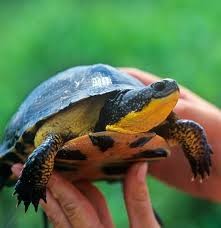
Blanding’s Turtle is a medium-sized turtle with an average shell length of approx. 18-23 cm. The distinguishing feature of this turtle is its bright yellow neck and chin. The shell is domed with numerous yellow or light coloured flecks or streaks on black. The Blanding’s turtle takes 14-20 years to reach sexual maturity. The clutch size varies from 5 to 12 eggs. Mating likely occurs in April and early May and hatching will take place in September or early October.

Range:

  • Mostly, the Blanding’s Turtle can be found in and around the Great Lakes basin, western Nebraska, southern Illinois, eastern Ontario
  • Isolated populations are found in Quebec, Nova Scotia and near the east coast of the United States
  • In Ontario, it can be found throughout the Southern and Central parts, except along the Bruce Peninsula
  • This map, provided by Ontario Nature, shows the Blanding’s Turtle range in Southern Ontario

map1

Habitat:

  • In spring, the Blanding’s Turtle can be found basking on rocks and logs
  • From late October until the end of April, the Blanding’s Turtle hibernates in mud at the bottom of permanent water bodies
  • It feeds off crustaceans, insect larvae, tadpoles, leeches, fish, frogs, crayfish, carrion, berries and vegetable debris
  • Prefers shallow waters with abundant vegetation
  • Nesting habitat can include sandy beaches and shorelines along lakes and ponds, roadsides or gravel roads

Threats:

  • The most significant threats the Blanding’s Turtle are loss of habitat, motor vehicles, and raccoons, coyotes, skunks and foxes that prey on their eggs
  • Our cool summers have impacted the reproduction of the Blanding’s Turtle
  • The Blanding’s Turtle appearance makes it look as though it’s always smiling. Because of this, poachers have been capturing the species for resale in the pet trade – thus effecting the population

Protection:

  • The Toronto Zoo and Earth Rangers have started an incubation/conservation project for the Blanding’s Turtle. They will collect and incubate 55 turtle eggs annually from at risk nests and care for the turtles until ready for release in the wilderness
  • Currently listed as Threatened under the Ontario Endangered Species Act, 2007
  • Currently listed as Threatened under the Federal Species at Risk Act
  • Designated as a Specially Protected Reptile under the Ontario Fish and Wildlife Conservation Act

What YOU Can Do to Help:

  • As more and more development occurs, it brings more road traffic to the area. When driving through marshy areas, keep an eye out for a crossing turtle
  • Should you see a Blanding’s Turtle at a pet store, contact the Ministry of Naturals Resources and make a report immediately
  • Should you encounter the Blanding’s Turtle in the public, make you sure you contact the Ministry of Natural Resources and report you sighting in detail
  • Currently 7 out of 8 of Ontario’s freshwater turtles are either endangered, threatened or of special concern. Educate children about the threats involving turtles and the importance of wetlands in our environment
  • Visit Earth Rangers to learn how you can participate, or donate to their conservation efforts (http://www.earthrangers.com/wildwire/blandings-turtle/)
  • Volunteer at your local Natural Club to learn more and participate in activities focused on species at risk

FUN FACTS:

  • The Blanding’s Turtle may live to be 80 years old, but some have been known to be 100!
  • Turtles do not provide care to their little ones once they hatch
  • Some scientists believe that the Blanding’s Turtle may also hibernate on land by burying themselves deep in moist soil through the winter
  • Blanding’s have a hinge at the front of their shell, this allows them to close the entire shell when retracting its head
  • The temperature of the incubated eggs determines the sex of the of the turtle (between 22° and 28° = males, between 30° and 32° = female)