
Click here to read the letter, signed by 96 organizations, including the Ingersoll District Nature Club, that was sent to The Honourable Steve Clark, Minister of Municipal Affairs and Housing, to express opposition to the use of Ministerial Zoning Orders (MZOs) to over-ride policy protections for Provincially Significant Wetlands (PSWs) in Ontario.
Author: ingersolldistrictnatureclub
Thank You To Our Volunteers
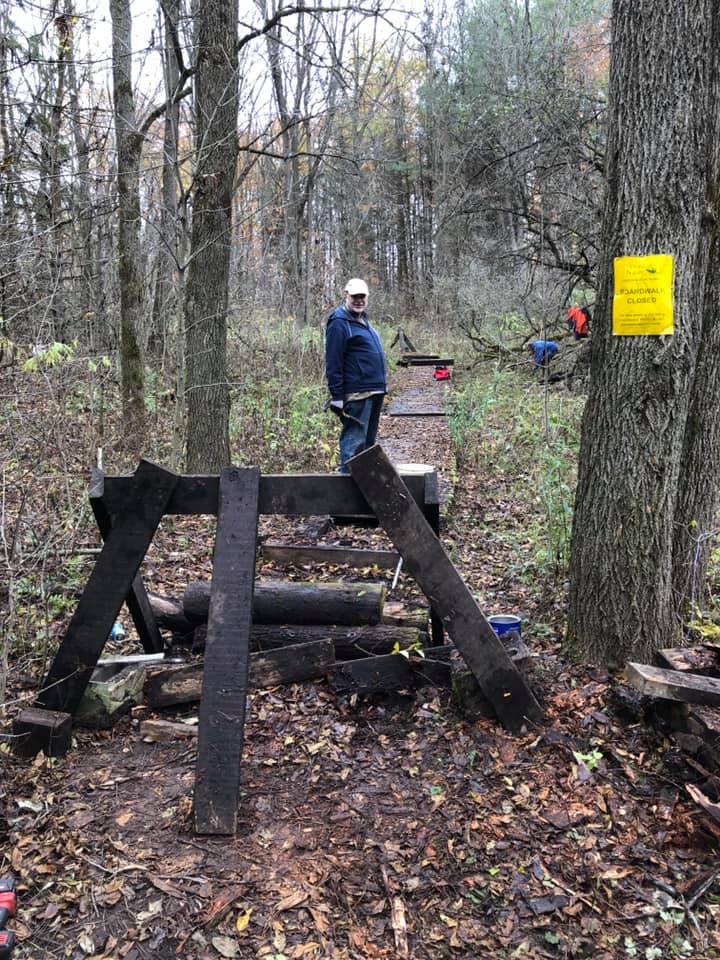
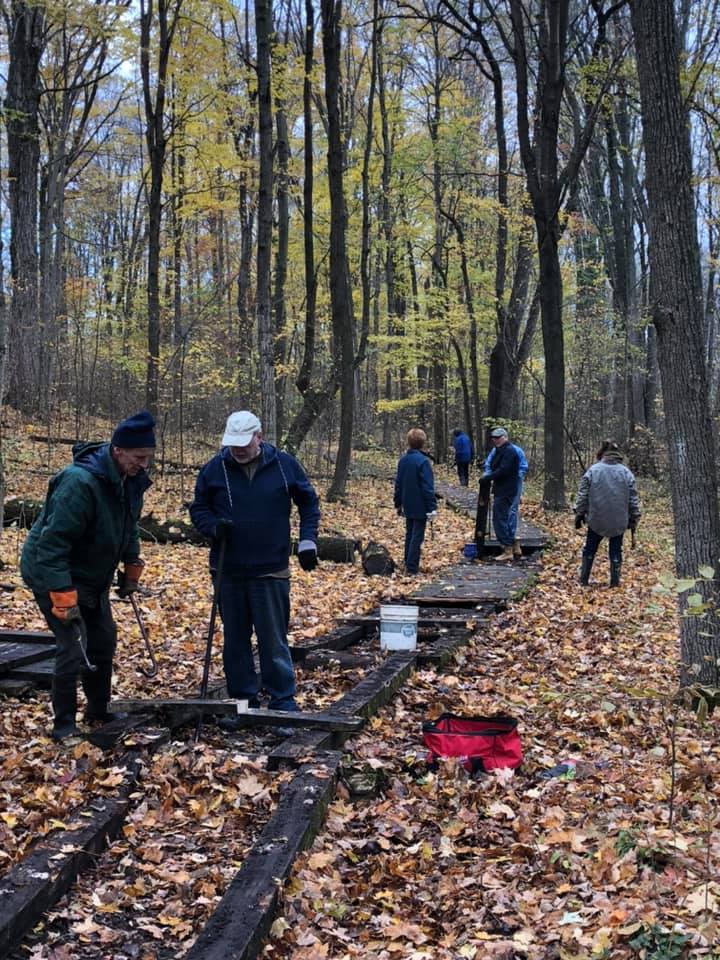
Thanks to the nine volunteers who helped start the dismantling of the boardwalks at the Lawson Nature Reserve on Saturday, October 31, 2020. A little muscle and teamwork and half the east side was deconstructed and part of the west. Both trails are decommissioned at the request of Ontario Nature due to safety concerns. Weather and increased use took their toll this year. New trails will be established next year. The bridge also was under repair. Ingersoll District Nature Club depends on volunteer hours to maintain the reserve for all to enjoy. Anyone willing to help would be warmly welcomed.



2020 Annual General Meeting Report
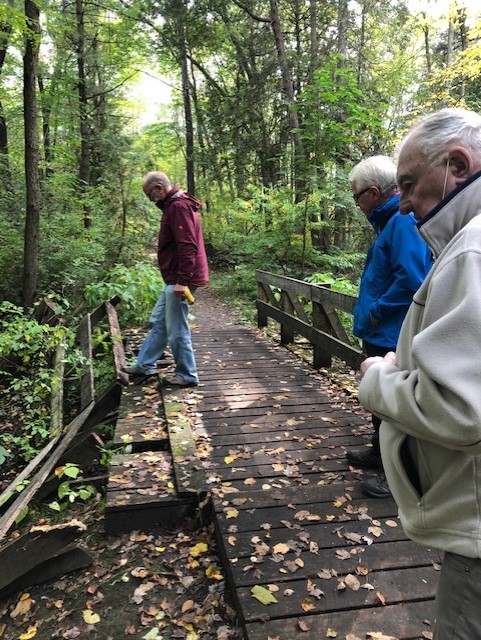
On the sunny, but brisk, afternoon of October 3, 2020, Ingersoll District Nature Club (IDNC) membership took part in our Annual General Meeting at the Lawson Nature Reserve. Business was conducted, followed by a walk of the nature reserve to enjoy the property and review the current state of our boardwalk system. Boardwalks are in disrepair and are not suitable for walking. At the request of Ontario Nature, both boardwalks are closed for the foreseeable future. You may walk on either side, close to the existing boardwalk, if you wish to traverse the entire pathway. You will also notice a new sign at the entrance, identifying the property as the Lawson Nature Reserve. This was designed by Ontario Nature and IDNC was happy to have it printed and installed.
AGM Update Items:
Following the meeting we have a revised executive committee. Please note the following:
- President – Peter Krats
- Past President – Sheila Fleming
- Vice President – Rob Alexander
- Treasurer – Phil Howard
- Secretary – Meg Walden
- Member at Large – Terry Parker
- Membership Outreach – Deb Bomans
NOTE: During the fall we typically undergo our membership renewals – this year we ask that you forward your membership cheque (we are only able to receive cheques at this time) to Phil Howard, Treasurer, at the following snail mail address. A tax receipt will be issued and returned via Canada Post.
Phil Howard, 54 Laurel Crescent, Ingersoll N5C 3S4
As a reminder, Family Memberships continue to be $25; Single Memberships $15. These funds help with upkeep at the Nature Reserve and with feeding the birds. Donations above and beyond are also gratefully accepted. Please note that fundraising is required for all of the upkeep at the Reserve and all maintenance / stewardship activities are volunteer driven.
Activities will continue to the end of the year, and will be followed by outdoor excursions only into 2021. As a result of COVID-19, any indoor activities are on hold. We hope to resume our lecture series at the Library in late spring of 2021 if allowed.
2020 Activities:
October 17th – Hickson Trail – 9:00 a.m. meet at the carpool for directions. Because of COVID, we will not carpool but drive separately. Physical distancing will take place on the walk.
October 31 – Lawson Nature Reserve – Salamander Boards – 9:00 a.m. – any member welcome, as Ontario Nature takes us through board set up and monitoring protocols.
November Festive Social – is cancelled at the Seniors Centre. Date to be announced for a “winter lights walk” through downtown Ingersoll and parks – late November/early December. To be followed by hot chocolate and short social gathering.
December 28 – Lawson Nature Reserve – Bird Count – 9:00 a.m. at LNR. We will assemble for our annual bird count. No experience necessary – always an interesting time! Dress warmly.
We will be looking for volunteers to help this fall (before the snow flies) to help dismantle our existing boardwalks. Please contact Sheila Fleming if you are interested in helping – work crews will be assembled. Call 519-485-2645.
For any further information, please feel free to contact the following:
Peter Krats – 519-425-0429 / pkrats@uwo.ca
Sheila Fleming – 519-485-2645 / galleryongeorge@gmail.com
Phil Howard – 519-572-3968 / philhoward@rogers.com

University Of Waterloo Study Links Planting Native Trees, Greenery With Lower Day-Time Temperatures
As study by the University of Waterloo has concluded that native trees, shrubs and greenery can help reduce day-time temperatures by over four degrees within a decade. According to a release from the university, researchers came to this conclusion from gathering thermal images of backyards before and after native plants were re-introduced.
Read the entire story in Kitchener Today at: https://www.kitchenertoday.com/amp/local-news/uw-study-links-planting-native-trees-greenery-with-lower-day-time-temperatures-2574524
A Message From OPAL President
The following message was sent along to us to share from President of the Oxford People Against the Landfill, Bryan Smith on July 8, 2020:
This message is for all OPAL Board members and the members of the boards of our Alliance partners – Transition to Less Waste, the Ingersoll District Nature Club, Oxford Green Watch, the Oxford Coalition for Social Justice, Oxford Environmental Action Committee…. (and feel free to pass this on!)
- It has been an exciting afternoon and I suspect you might have heard that today at Queen’s Park, Bill 197, which contains a section (2.3) related to the “demand the right” and thus the dump fight, was read and voted on. It passed first reading. (It needs three readings).
- The CBC is already on the story as are or will be other media. Sam Coghlan of OPAL’s Zorra committee passed on the link below. Have a read. Look for updates in other media or in the
ERO number 019-2051 (Goggle will find it as did our ally Suzanne Crellin).
https://www.cbc.ca/news/canada/london/ingersoll-legislation-right-refuse-landfill-1.5642584
- Next steps include the following and more:
-
- Marking July 16 at 1:00 pm in your calendar for a gathering in Ingersoll where Ernie Hardeman accompanied by local mayors and some Ministers will announce this part of the bill. Be there. Stay 6 feet away from those who do not share your home, circle or bubble. Even at that distance, wear a mask. (We will try to have some, but much much prefer that you bring and leave with your reusable one.( No garbage means no dump). Chances are that the event will be outdoors, so be prepared for more scorching sun by bringing a parasol, or the alternative, so a slicker.
- Anti-dump signs would be great at the event and great on your lawn. If you don’t have one for all to see already, contact me by phone 519 456 5270 or reply by email.
- Continuing your conversations with Zorra residents and Councillors, SouthWest Oxford residents and Councillors and Ingersoll residents and Councillors about all the reasons why they should resoundingly reject Walker’s dump plan
- Thanking all who have helped to get us this far.
- Encouraging Ministers Yurek and Hardeman to persuade all MPPs at Queen’s Park to pass Bill 197 through second and third readings with the provisions around the right to say “No” all intact in the bill.
- Telling people who ask “Where should it go?” to have a look at CBC’s Gem’s “Good People” episode 5 which has some very beautiful landscapes (and their opposite) in Zorra and some very practical solutions.
- Taking deep breath, realizing that this has been an almost 9 year battle during which we have gained strength with every passing day, and preparing to encourage all decision-makers to say “No” to Walker’s dump.
Thank you. It’s not over, but this is major progress!
Bryan
Ontario Municipalities To Be Given Right To Approve New Landfill Proposals
Ontario Municipalities to be given right to approve new landfill proposals
With introduction of new legislation, Ingersoll Council’s long effort nears a successful conclusion.
Press Release from the Town of Ingersoll
INGERSOLL, ONTARIO, July 8, 2020 — The three-year effort of Ingersoll Council to champion landfill approval rights for local communities has achieved a significant milestone. The Ontario Government has introduced legislation that will provide municipal governments with the right to approve all new landfill projects. The legislation provides that municipalities within 3.5km of a proposed landfill site – whether a host municipality, or a neighbouring municipality – will have the right to approve or reject these projects. If a landfill site proponent has not received this municipal approval, the Ministry of the Environment, Conservation, and Parks (MOECP) would not approve its proposal.
Prior to this new legislation being passed, private sector waste companies had no obligation to gain the support of the local municipal governments. While a community like Ingersoll may have objected to becoming home to a new landfill site, the provincial government’s longstanding environmental assessment process effectively tied the hands of Town Council to demand any changes, including whether or not to allow the project to proceed at all.
These changes to Ontario’s Environmental Assessment legislation will give each of the municipal councils of Ingersoll, Southwest Oxford, and Zorra Township, the opportunity to vote on whether or not to approve Walker Industries’ proposed project to build and operate a 17 million tonne landfill site in a Zorra quarry.
“The legislation will ensure that each municipal council will be able to vote NO to Walker’s proposed project,” said Ingersoll Mayor, Ted Comiskey. “Such a no vote by any Council would mean that Walker would be unable to receive approval from the Ministry of the Environment, Conservation, and Parks.”
To develop the support of the provincial government, Ingersoll Council created the Demand the Right Coalition of Ontario Municipalities (www.demandtheright.ca). With Mayor Comiskey acting as its Chair, the Coalition grew to 148 municipalities representing over 70 percent of Ontario’s population. Each of these communities passed Council Motions demanding that the wishes of municipal governments and their citizens be respected for all new landfills anywhere in the province.
Comiskey said, “On behalf of Ingersoll Council, I wish to express our sincere appreciation to Premier Ford for keeping his election promise and Environment Minister Yurek for his work to develop and introduce this legislation. We are especially appreciative for the efforts of Ernie Hardeman who first championed local approval and has continued to pursue the issue as our MPP.”
During the legislative process, details can change. The Town will actively participate in the process, updating the community on a regular basis, and until the legislation is passed into law.
“As it will likely take through the summer for the legislation to pass,” Comiskey said, “we’ll hold off any big celebration. I am optimistic, but we have much more work to do. It will be important for local residents to make sure their own town council knows where they stand.”
Please also see the CBC story.
Conservation Authorities’ Letter To Ontario Premier
Enclosed is a letter sent by Ontario Nature to Ontario Premier Doug Ford, regarding the value of Conservation Authorities. Ontario Nature received cross-sectoral support from 112 signatories, including from the Ingersoll District Nature Club and other environmental, agricultural and engineering organizations and businesses. This is another important pushback to the Ontario government to stop them from eroding the mandate of all our conservation authorities. This would be a particular blow to our part of the province, with the Thames watershed covering virtually all of southwestern Ontario.
Read the letter at: Support for Ontario’s Conservation Authorities – Letter to Premier Ford

Important Notice: COVID-19 And The Lawson Nature Reserve
Ontario Nature knows that getting outdoors to appreciate nature is a key element of our physical and mental well-being, especially at times such as these. In light of the current situation around the coronavirus (COVID-19) outbreak, we strongly encourage everyone to practice social distancing. Please do not gather in groups larger than two people, keep two metres away from other individuals and keep your dog on a leash at all times. Please do not touch any railings, signs or other surfaces to avoid any possible transmission.
All events taking place on Ontario Nature reserves have been cancelled and we are not doing trail maintenance until further notice. Use of our trails is at your own risk.
If you have any questions, please call 1-800-440-2366. Please follow the advice of health and government officials. Practice good hand hygiene, keep your distance and be respectful of others.
Ingersoll District Nature Club supports Ontario Nature in their decision to reduce the opportunity for the spread of COVID-19.

Sharing Is Caring (For Our Planet)
Nowadays, most people know about the urgent threat of climate change – but not many are aware that nature is one of our biggest allies against it! We need to raise awareness and share the message with others 📢
Not a fan of public speaking? We’ve got your back – share this video and let Greta Thunberg do the talking 💪

Minute To Win It
The quickest and easiest way to show your support for nature and our planet this Earth Hour (besides switching off your lights 😉).
Add your Voice and submit a pledge to let world leaders know that you demand urgent action to reverse nature loss – it’ll take less than a minute!

