Did you know that April is National Garden Month? The changing weather promises good growing seasons to come very soon and National Garden Month encourages people in the northern hemisphere to get out and start preparing that soil. Learn more at https://www.daysoftheyear.com/days/garden-month/
Reuse-A-PalooZaha
Reuse-A-PalooZaha is returning! On April 30, the free swap meet to help the environment will be taking place at the Brownsville Pavillion from 8:30 a.m. – noon. Find out more at http://www.reuseapaloozaha.ca/
Tourism Oxford Video On The Lawson Nature Reserve
From Tourism Oxford:
We’re BACK with another trail video over on our YouTube channel. This time we talk Lawson Nature Reserve which is maintained by the Ingersoll Nature Club. As always, we ask that you stay on the trail, give wildlife lots of space and if the parking lot is full either choose a different trail or come back at a different time to avoid overuse! https://www.youtube.com/watch?v=lWLqff71xFU
Spring 2022 Issue Of The Trail Times
The Spring 2022 issue of the Trail Times, published by the Oxford County Trails Council (https://www.facebook.com/beachvilletrail/) is now available.
Read more about the Eastern Towhee, 2022 plans for the Oxford Thames River Trail, Hickson and Woodstock Trails updates and the importance of cleaning up after your dog while on the trails.
Finding The Mother Tree, A Public Talk And Discussion Featuring Dr. Suzanne Simard
From Nature Canada:
Register for a discussion with author Dr. Suzanne Simard on the urgent need to rethink our relationship with the natural world!
March 26, 2022 – 7 p.m. EST
Nature Canada, in partnership with the Southminster United Church and Enviro Crew invite you to join us for Finding the Mother Tree, a public talk and discussion featuring Dr. Suzanne Simard. She is widely known for her work on how trees interact and communicate using below-ground fungal networks. Come learn about the magnificence and intelligence of trees and have the opportunity to ask Dr. Simard your questions. The event is happening in-person, but as we have many supporters across the country, we have ensured to include an option to view the event from the comfort of your own home.
Nature Canada Webinar: Protecting North American Forests For People And Nature In The Face Of A Changing Climate
From Nature Canada:
Join Nature Canada for the March 22nd (noon to 1 p.m.) webinar: Protecting North American Forests for People and Nature in the Face of a Changing Climate
In North America, the United States and Canada have both made unprecedented commitments to biodiversity protection and natural climate solutions, including the protection of 30% of their lands by 2030 (aka ″30×30″). Join us on March 22nd for the Connecting for Conservation webinar series, panelists from Nature Canada, along with organizations from the US, and an Indigenous nation will discuss the importance of protecting forests in order to achieve these goals. Together, they will explore the need to address underlying barriers to the realization of strong natural climate solutions policies, as well as opportunities for the development of sustainable economies, which can in turn enable Indigenous self-determination and increase forest protection ambition in North America.
Tell Ontario To Stop Driving Caribou Decline
Add your voice to the David Suzuki Foundation‘s initiative to tell Ontario that it’s time to take caribou survival serious.
Ontario and Canada have been working to create a conservation agreement, defined under the federal Species at Risk Act as a voluntary agreement “to benefit a species at risk or enhance its survival in the wild.”
In the framework, Ontario continues to pat its own shoulders about its so-called “robust provincial framework that includes laws, policies and processes to protect and recover caribou and their habitat in Ontario.”
It doesn’t mention that the forest industry has been exempted from the Endangered Species Act, that the insurance plan to protect caribou outlined in the Caribou Conservation Plan has never been implemented and that the Range Management Policy, in place since 2014, has led to ongoing caribou declines.
Science has been available since 2008 that outlines a risk-based approach to caribou management by applying disturbance thresholds. The 2012 federal recovery strategy required provinces to apply it to every caribou range, but Ontario has failed to do so.
The framework for the conservation agreement as presented will pave the way for more business-as-usual forestry operations in the province. It must not be finalized unless it is significantly improved.
Please take a moment to let the provincial and federal governments know that funnelling money into status quo operations that will continue to fragment caribou habitat flies in the face of commitments to halt and reverse nature loss.
Confronting Canada’s Climate Paradox
On February 28, 2022, the Intergovernmental Panel on Climate Change released a report on climate “Impacts, Adaptation and Vulnerability.” It’s a lot to take in, so Jodi Stark, Public Engagement Specialist for Climate Solutions, breaks down what it means in an article on the David Suzuki Foundation’s website.
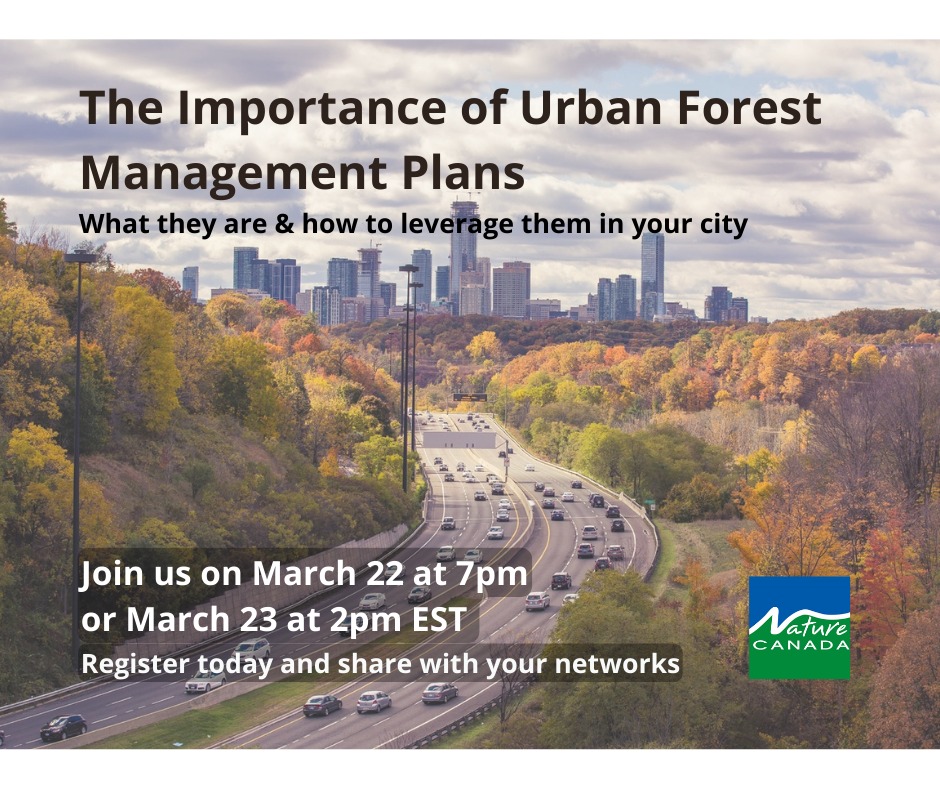
Urban Forest Management Plans & The Federal 2 Billion Tree program
An urban forest management plan is a massive document which outlines a city’s strategy for both maintaining and improving its urban forest. Although important information like tree canopy targets, biodiversity goals and tree by-laws can be found within their pages, locating the information can be difficult if you don’t know what to look for.
Register for one of Nature Canada’s webinars to learn what to look for in these documents and how they can be used by your community to bring back biodiversity and much needed habitat to your region. The webinar will also cover information on the federal government’s 2 Billion Trees program so you can ensure your city is taking advantage of available funding!
Bird Bath And Feeder Care
Whether you feed birds throughout the winter or year round, it’s important to practice good bird feeder and bath hygiene.
Dirty feeders and baths not only expose birds to potential toxic molds and bacteria, they can also spread diseases and viruses that are harmful to bird and human health.
The Ottawa Valley Wild Bird Care Centre has produced this great article on Bird Bath and Feeder Care.