Endangered Species In Focus: Yellow-Breasted Chat

Yellow-breasted Chat (Icteria Virens)
 ImageImage

Status: Endangered, Special Concern Nationally

 Factoid:

  • The yellow-breasted Chat’s song consists of a weird assortment of clicks, whistles and even chuckles;
  • They will lay from 3 to 5 creamy white eggs with reddish brown blotches or speckles, incubated by the female, hatch in 11 to 12 days;
  • Both parents tend the young, who fledge in approximately 8 to 11 days;
  • Nesting occurs mid-May to June

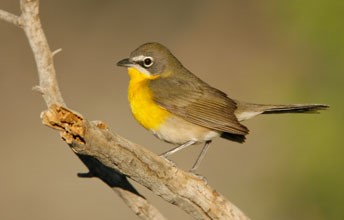
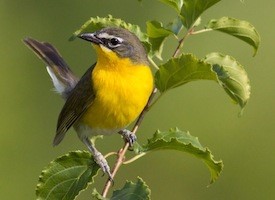
Description: The Yellow-breasted chat is a medium-sized songbird, about 18 centimetres long, with a long tail. It has a bright yellow chest and throat, olive-green back, white circles around its eyes, white belly and undertail.  This bird eats insects and berries gathered from the foliage of low, dense shrubs, or from the ground.

  • The Juvenile Yellow-breasted chat lacks yellow and has dusky spotting on throat and chest

Important Dates:

Nov. 30, 2011: Species is listed as “at risk”

Jan. 24, 2013: Species reassessed and labeled as “endangered”

Range:

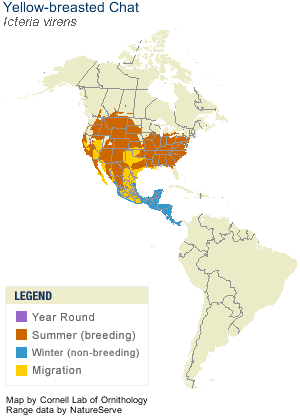
  • Found in much of United States. In Canada, it lives in southern British Columbia, the Praries, and southwestern Ontario, where it is concentrated in Point Pelee National Park and Pelee Island Lake Erie
  • Winters along the Gulf of Mexico

Habitat:

  • Lives in thickets and scrub, especially locations where clearings have become overgrown.
  • Spend winters in coastal marshes
  • Nests in shrubs

Behaviour: Gleans prey from foliage of low, dense shrubs, or from ground. Holds food with foot

Food:  Small invertebrates, fruits

Threats:

  • Habitat of overgrown clearings is disappearing

Protection:

  •  The Ontario population has declined by 55% over the past 20 years and it is declining in neighboring jurisdictions as well
  • There are likely fewer than 10 breeding locations in Ontario
  • The population in the Point Pelee National Park also receives protection

What you can do to help:

  • Maintain and enhance remaining riparian habitat including cottonwoods, aspen, rose thickets and snowberry;
  • Protect off-road vehicles from disturbing and degrading stream-side vegetation;
  • You can use an online form to report your sightings to the Natural Heritage Information Centre (http://nhic.mnr.gov.on.ca/)
  • Private land owners have a very important role to play in species recovery. You may be eligible for stewardship programs that support the protection and recovery of species at risk and their habitats
  • Volunteer with your local nature club or provincial park
  • Bird Studies Canada is working to advance the understanding, appreciation and conservation of wild birds and their habitat in Ontario and elsewhere. For more info on how to help, visit: www.bsc-eoc.org

Fun Facts:

  • Yellow-breasted Chat’s in Ontario tend to be more subdued in colour than their relatives in Western Canada, and separate subspecies are recognized;
  • The Yellow-breasted Chat’s song consists of a weird assortment of clicks, whistles and even chuckles;
  • Was first described in 1758 by Carolus Linnaeus, Swedish botanist, physician and zoologist;
  • Song is louder and lower pitched than those of their other wood warblers; one common phrase consists of three whistles exactly like someone calling their dog!
  • Chats often sing at night

 Image


The Snapping Turtles of Centreville

The Snapping Turtles of Centreville

By Karen Paton-Evans

This spring, travelers along Mill Line near Centreville, the gently winding road ending in Karn Road to the south and Beachville Road to the north, will need to be watchful for the annual day-long trek that mother Snapping Turtles make to lay their eggs.

In late May and June, those mother snappers, aged 17 years and older, leave the safety of Centreville Conservation Area’s marsh, make the slow trek across Mill Line. After crawling up Indian Hill, they will find the right spot to dig a large hole and lay up to 50 eggs, before heading back to the pond.

It will not be until autumn that the loonie-sized hatchlings will hatch and instinctively make their way to the Centreville Pond in the Conservation Area, which is overseen by the Upper Thames River Conservation Authority and cared for by the Township of South-West Oxford. As these turtles get older, some will be found in the park’s one-acre pond, and even “sunbathing” on logs. Mostly, snappers stay in the water, the natural habitat that gives them life. In turn, snappers play an important role in keeping our lakes and wetlands clean.

As Canada’s largest freshwater turtle, according to the Ontario Ministry of Natural Resources, the Snapping Turtle can grow up to 36 cm or longer (some Centreville snappers have been known to have even bigger shells) and weigh between 4.5 and 16 kg.

The Snapping Turtle takes 15-20 years to reach maturity, and therefore, the species’ survival rate is impacted by adult mortality rates. However, with the right environmental conditions, the Ministry of Natural Resources (MNR) states, “Snapping Turtles are believed to live well over 100 years!” which means, the huge Snapping turtles residing in Centreville Pond could very well be the hamlet’s oldest residents.

The Snapping Turtle is listed as Special Concern under the Ontario Endangered Species Act and as Special Concern under the Federal Species at Risk Act. Snappers are designated as a Specially Protected Reptile under the Ontario Fish and Wildlife Conservation Act. All of these acts protect both the snapping turtle and its habitat. The habitat of this species is also protected by the Ontario’s Provincial Policy Statement under the Planning Act.

“As with many other rare plants and animals, the Snapping Turtle depends on wetland habitat,” the Ministry of Natural Resources states, and adds that “You can help by protecting any wetlands and surrounding natural vegetation on your property.”

Centreville residents do their best to protect their snapper neighbours by accommodating nesting turtles and protecting their eggs; serving as traffic directors when the snappers are crossing Mill Line; and volunteering to maintain and watch over the Centreville Conservation Area and Pond.


This Week’s Endangered Species: The Snapping Turtle

The snapping turtle occurs, though it is primarily limited to the southern part of Ontario.  They are found in Mountains.  The snapping turtle’s range is contracting, and the Committee on the Status of Endangered Wildlife in Canada lists it as a species of special concern.

The Snapping Turtle, or the Chelydra serpentine, is the largest freshwater turtle in Canada. With a range that extends from Canada through areas of the United States east of the Rocky Mountains all the way to Ecuador, the Snapper is found in Canada from the Maritimes west into southern Saskatchewan and parts of southern Alberta, with isolated populations in New Brunswick, but only in the southern part of Ontario. (The following map shows the range of the turtle in Southern Ontario: http://www.ontarionature.org/protect/species/reptiles_and_amphibians/map_snapping_turtleSO.html)

You’ll be forgiven if you think the “snapper” looks like something out of Jurassic Park. The Snapping Turtle is certainly most prehistoric-looking turtle species to be found in Ontario, with a long tail (which can be longer than their bodies) that has a series of triangular spikes along the top that are reminiscent of those of a stegosaurus. The Snapping Turtle reaches an average length of 20-36 cm and a weight of 4.5-16.0 kg. The carapace (upper shell) is very small (47 centimetres is the maximum length), is tan or olive to black in colour, has a coarsely serrated anterior (front) edge and three longitudinal ridges, and is often covered with algae. The plastron (lower shell) is also very small.

Hatchlings from “clutches” that could contain up to 60 ping-pong-ball-shaped eggs at a time are about the size of a loonie and are smaller (two to three centimetres in length) and darker than adults, with pronounced ridges along the length of their shell.

The Snapping Turtle is named such because, unable to withdraw completely into its shell for protection. Although adult Snapping Turtles have few natural predators, they nevertheless have developed a defence of snapping repeatedly to scare potential enemies away. In water, the Snapping Turtle rarely snaps at people or other potential threats and will simply swim away if threatened.

Snapping Turtles spend most of their lives in water and they can be found in almost any freshwater habitat. The irony is that they are not particularly good swimmers, often observed as simply walking on the bottom. Therefore, their preference is to shallow waters near abundant vegetation so they can hide under the soft mud and leaf litter, with only their noses exposed to the surface to breathe. It may be surprising how small the wetlands are that they inhabit, including ponds and ditches. They will hibernate in the mud or silt on the bottom of lakes and rivers, usually not too far from the shore.

During the winter months, Snapping Turtles bury themselves in the mud at the bottom of a pond to keep themselves from freezing. While they may move a little during this period, they normally will not eat.

Snapping Turtles will take advantage of man-made structures for nest sites, including roads (especially gravel shoulders), dams and aggregate pits as well as embankments or a shoreline. In Ontario, females do not begin to breed until they are 17 to 19 years old. They dig a nest in late May or June in an open area, usually one with loose, sandy soil, almost any area they can excavate.

They are omnivorous and feed on various aquatic plants and invertebrates, as well as fish, frogs, snakes, small turtles, aquatic birds and relatively fresh carrion. Approximately 90 percent of their diet consists of dead animal and plant matter, and this species plays an important role in keeping lakes and wetlands clean.

A Snapping Turtle will normally take 15-20 years to reach maturity and has a slow reproduction rate. Adults can live up to 70 years in the wild. As a result, the loss of even a few turtles from a population each year is enough to cause the population to decline. Snapping turtle populations are vulnerable to the threats of road mortality, hunting and poaching. Eggs in nests around urban and agricultural areas are subject to predators such as raccoons, herons, hawks,  crows, large fish, snakes, and striped skunks.

Despite the snapping turtle being a species at risk in Ontario, the hunting of the species is still legal.

This Week’s Endangered Species: The Bobolink (Dolichonyx oryzivorus)

A medium-sized songbird found in North American tallgrass prairie, other open meadows and hay fields, male Bobolinks are black with a white back and yellow collar during their summer breeding season. (Some have described their striking look as wearing a tuxedo backwards.)

Bobolink molt twice a year, completely changing all their feathers on both the breeding and wintering grounds. When the male grows new feathers on the wintering grounds they all have yellowish tips, so he still looks like a non-breeding bird. Eventually the pale tips wear off to reveal his striking black-and-white breeding colors.

By late summer, male bobolink will lose much of this breeding plumage and more closely resemble the female’s tan colour with black stripes.

Bobolinks are related to blackbirds, which are often polygynous, meaning that males may have several mates per breeding season. Bobolinks are polygynous, too—but they’re also often polyandrous: each clutch of eggs laid by a single female may have multiple fathers.

Because Bobolinks spend much of their time out of sight on the ground feeding on insects and seeds, they may seem to appear out of nowhere, spotted flying in the sky or over the tops of vegetation singing a bubbling musical song.

The Bobolink breeds across North America. Here, in Ontario, it is widely distributed throughout most of the province south of the boreal forest, although it may be found in the north where suitable habitat exists. The Bobolink is considered a “wide ranging species” and in fact, the Bobolink is one of the world’s most impressive songbird migrants, travelling approximately 20,000 km to and from South America. Throughout its lifetime, it may travel the equivalent of 4 or 5 times around the circumference of the earth.

Bobolinks often build their small nests on the ground in dense grasses. Both parents usually tend to their young, sometimes with a third Bobolink helping. The species name of the Bobolink, oryzivorus means “rice eating” and refers to this bird’s appetite for rice and other grains, especially during migration and in winter.

A map outlining occurrences of the Bobolink in Ontario can be found at:

http://www.mnr.gov.on.ca/en/Business/Species/2ColumnSubPage/groups/lr/@mnr/@species/documents/geospatialmaterial/mnr_sar_bblink_eo_map_eng.pdf

Celebrate World Frog Day!

March 20, 2014 has been designated World Frog Day (also known as Save the Frogs Day) to coincide with the first day of spring. (The release, a day later, of Muppets Most Wanted, starring perhaps the world’s most famous frog, Kermit, is just a happy coincidence.)

First celebrated in 2009, World Frog Day has become the world’s largest day of amphibian education and conservation action. Many are using this designated day to focus on the worldwide decline in the amphibian population in locations across the globe. Today, one-third of the world’s amphibian species are threatened with extinction. Since 1979, 200 frog species have disappeared completely. This decline in population has been attributed to disease, habitat destruction and modification, climate change, pollution and pesticide use.

In 2013, over 270 events were held as part of Save the Frogs Day in 30 countries around the world.

There is evidence that the frog has been around for 200 million years. Today, there are approximately 5,000 species of frogs in the world from the Wood Frog that freezes and then thaws every winter to the Australian Rocket Frog who can leap over 50 times its own body length.  Frogs of one species or another can be found on every continent, with the exception of Antarctica.

How the Frog Helps You

  • Tadpoles keep waterways clean by feeding on algae.
  • Adult frogs eat large quantities of insects, including those such as mosquitoes that can transmit fatal illnesses to humans.
  • Frogs produce a wide array of skin secretions, many of which have the potential to improve human health through their use as pharmaceuticals. (Approximately 10% of Nobel Prizes is Physiology and Medicines have resulted from investigations that used frogs.)

For more information, visit www.savethefrogs.com


This Week’s Endangered Species: The Barn Swallow

This Week’s Endangered Species is the Barn Swallow (Hirundo Rustico). Although of African Origin, the Barn Swallow has the largest range of any swallow, found in Europe, Asia and Africa as well as the Americas. 

The Barn Swallow is distinguished from other swallows by having a wider breast band and less white in their tails. They also fly much lower than most other swallows.

They associate closely with humans, nesting in buildings and other structures.