This Week’s Endangered Species: The Acadian Flycatcher

Residing in mature deciduous forests and streamsides, the Acadian Flycatcher has an olive-green crown, back and tail with a pale whitish throat and breast. The Acadian’s most prominent feature of this bird is the bold white ring around the eye, and two whitish horizontal bars on the wing. The beak is short but wide-based, allowing a big opening for snatching insects out of the air.

Above and beyond its physical features, the Acadian Flycatcher is best distinguished from other Flycatchers by its explosive song often interpreted as “peet-sah”, with a strong emphasis on the first syllable.

To find out where you can see an Acadian Flycatcher in Southwestern Ontario, check out this map:
http://www.mnr.gov.on.ca/stdprodconsume/groups/lr/@mnr/@species/documents/geospatialmaterial/acadian_flycatcher_map_eng.pdf
Canada Water Week – March 17-23, 2014

Did You Know?

March 17-23, 2014 is Canada Water Week, a celebration of water from coast-to-coast. Canada Water Week is held annually in the third week of March so as to coincide with World Water Day, which takes place on March 22.

This year’s campaign is Watersheds 101. A watershed is defined by Canadian Geographic as “an area of land where all the surface water drains into the same place, whether is it a creek, a stream, a river or an ocean.”

Canada has five main watersheds: the Atlantic, the Hudson Bay, the Arctic, the Pacific and the Gulf of Mexico. There are, however, hundreds of smaller sub-watersheds throughout Canada.

Our area is located in the Thames River watershed, which flows downstream into Lake St. Clair. Nestled in the agricultural heartland of Southwestern Ontario in close proximity to Lakes Huron, St. Clair and Erie.  The second largest watershed in southwestern Ontario, the Thames River is 273 km long and drains 5,825 square kilometres of land. The Thames is accessible to a half million people residing in its watershed.

Sources:

Canada Water Week: http://canadawaterweek.com/

The Canadian Heritage Rivers System: http://www.chrs.ca/Rivers/Thames/Thames-F_e.php

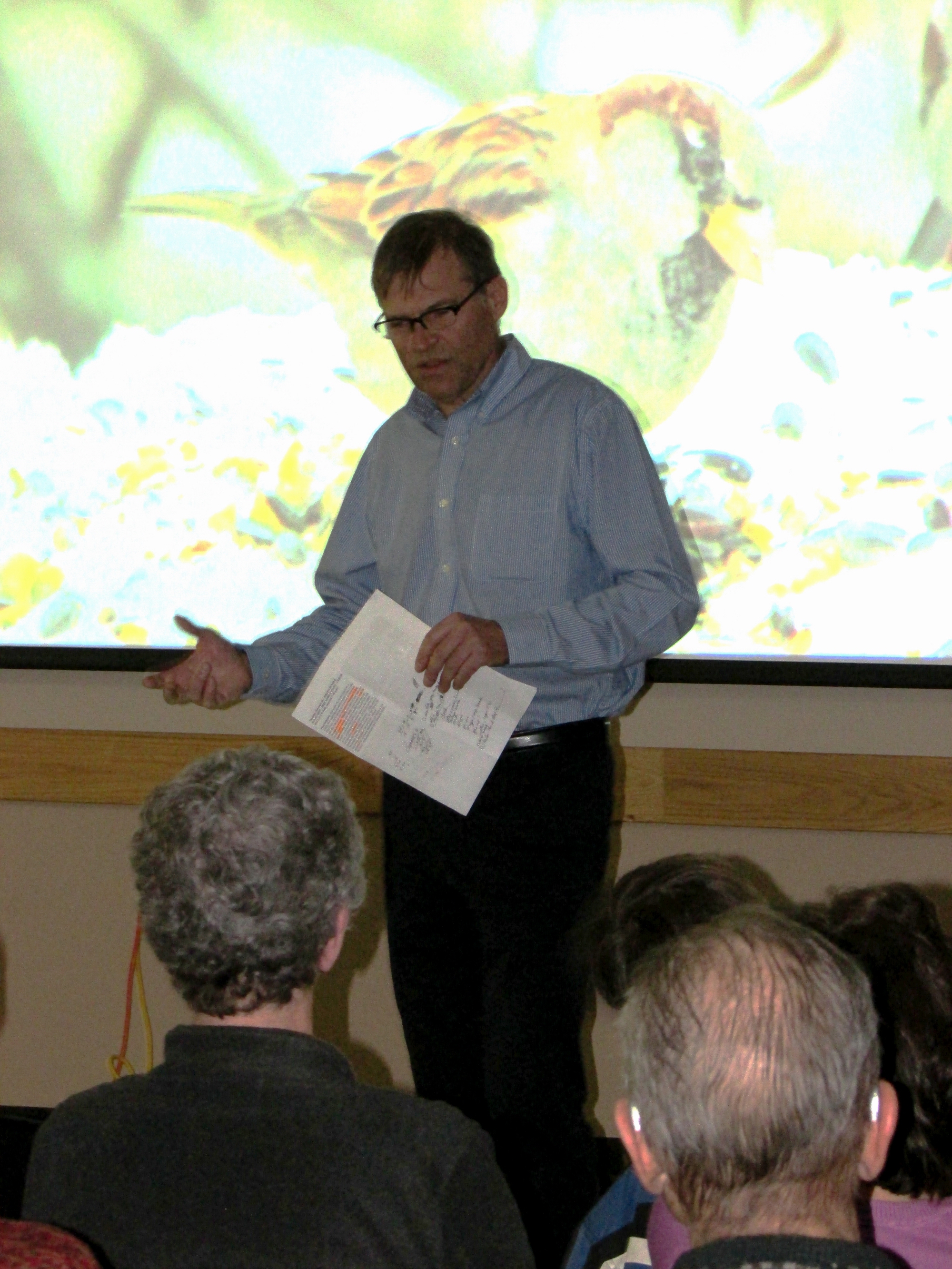
Guest Speaker Paul Nicholson: “What’s in my Backyard?”

Image

Paul Nicholson addresses a flock of Ingersoll birders.

February 20th, 2014

Paul Nicholson, the London Free Press columnist who writes, The World Outdoors, gave an entertaining and focused talk about local winter birds to an audience of over forty children and adult ‘birders’ on Thursday at Unifor Hall, here in Ingersoll.  Using images of birds Mr. Nicholson had spotted during his hikes with members of the IDNC, he discussed how the observant and attentive birder can identify species through a variety of clues, such as size, colouring, behaviour, sound, habitat, and time-of-year.  He made it apparent how many beautiful and rare birds are found, “right here, in our own backyards,” that can inspire us.  Paul also reminded his audience that even on the coldest of days, Shirin Yoku (“forest bathing”), helps us maintain a healthy mind and soul.

The evening closed with Mr. Nicholson being made an honourary member of the IDNC.

Visit To Meadowlily Nature Preserve – September 28, 2013

Come walk with us – on a guided tour of Meadowlily Nature Preserve on the morning of Saturday, September 28th.  Located within the City of London, on the south side of the Thames River between Highbury and Meadowlily Road, this 14.5 acre site is comprised of floodplain, open meadow and upland forest. It is an Environmentally Significant Area (ESA) and is stewarded by the Thames Talbot Land Trust.  Local Ingersoll members will carpool at 9:15 from the Municipal Parking Lot behind the arena.  Tour time is 10:00 a.m.  For more information, call Wayne or Meg at 519-485-4220.

Transitions To Less Waste At Canterbury Festival A Success!

IDNC’s participation at Transition to Less Waste’s washing station at Ingersoll’s Canterbury Folk Festival (July 12-14) helped reduce waste in the community – happy volunteers washed over 1500 plates, keeping more waste out of the local landfill.  Thanks to Rachel Egan and Emily Cude for spearheading this innovative initiative!  Heating water through solar power, the washing station is geared to clean plates and cutlery for patron’s use from festival-sponsored food events and retail vendors, as well as add an educational component on recycling and waste reduction.  For more information, go to http://transitiontolesswaste.org/.

Why ‘Adopt-A-Wild Bird’?

People love feeding birds; everyday many fill their bird feeders in their back yards so they can watch from afar.

We wanted to provide that same service for the wild birds that frequent the Lawson Nature Reserve, giving visitors an opportunity to ‘Adopt-A-Wild Bird’. This is a simple concept, which goes to help a great numbre of birds who are seeking a snack. Sound like something you would be interested in? Allow us to continue…

All you need to do is forward a cheque addressed to:

Ingersoll District Nature Club

c/o Lana Graham, Club Treasurer

255 Mutual Street, Ingersoll, ON  N5C 2A9

You can spend $15 dollars (for a specific bird), or you can spend $100 and feed the entire flock of wild birds. You can choose which kind of birds you wish to feed –  are you partial to blue jays? mourning doves? chickadees? Well they’re all options, and you can make sure that they spend the day on a full stomach!

Not only does adopting wild birds bring with it a whole host of new friends, it also helps support our mission of keeping the Reserve as beautiful and entertaining as it can be. That way, our birds continue to fly, eat, and rest safely within our woodlands.